Heart Chakra (Anahata): How to Open, Heal & Balance Your Center of Love

Updated: Aug 17
Part 4 of the 7 Chakra Series
There is a place in the center of your chest that knows things your mind has not yet figured out. It softens when someone you love walks into the room. It tightens when you feel unseen. It aches after loss, and it opens — sometimes unexpectedly — in moments of pure gratitude or beauty.
That place is Anahata, your heart chakra. And in many ways, it is the most pivotal energy center in the entire chakra system.
If you've been with us through the first three posts in this series, you've already done meaningful work. You rooted yourself through the base of your spine, awakened your creative and emotional flow through the sacral center, and claimed your personal power in the solar plexus. Now, at the midpoint of the seven chakras, the energy shifts. We move from the more physically-anchored lower chakras into the heart space — the bridge between the earthly and the ethereal. Everything below is about survival, pleasure, and will. Everything above is about expression, perception, and connection to something larger than yourself.
Anahata is where those two worlds meet.
What Is the Heart Chakra?
Sanskrit name: Anahata — meaning "unstruck" or "unbeaten," referring to a sound that exists without two things striking together: the sound of the soul itself.
Location: Center of the chest, at the level of the heart.
Color: Green (and sometimes pink, particularly associated with unconditional love and compassion).
Element: Air — expansive, invisible, life-giving, and impossible to hold.
Mantra: YAM
Frequency: 639 Hz — known widely as the "Love Frequency" or "Miracle Tone," associated with DNA repair, emotional healing, and transformation.
Associated with: Love, compassion, empathy, forgiveness, connection, grief, and the capacity to give and receive openly.
The heart chakra governs not only romantic love but all forms of love — self-love, love for others, love of life itself. It is also where we process grief, loss, and heartbreak. When this center is balanced, you feel a natural sense of warmth toward yourself and others, a quiet openness that doesn't need to be earned or forced. When it is blocked, you may notice yourself closing off, guarding, or swinging between emotional extremes.
Signs Your Heart Chakra May Be Out of Balance
The heart chakra can manifest imbalance in two directions: it can become blocked and contracted, or overactive and ungrounded. Here is how each tends to show up.
When the Heart Chakra Is Blocked
A blocked or underactive Anahata often feels like a kind of emotional withdrawal — a protective shell that formed to keep pain out, but ended up keeping connection out too.
You might notice:
Difficulty trusting others, or a persistent fear of being hurt
Holding on to old grievances; finding it hard to forgive
A sense of emotional numbness or disconnection from your feelings
Trouble receiving love, care, or compliments — deflecting or minimizing them
Social withdrawal, loneliness, or a sense of isolation even in company
Physical tension in the chest, shoulders, or upper back
A tendency toward codependency or self-sacrifice without replenishment
When the Heart Chakra Is Overactive
On the other end, an overactive heart chakra can look like love, but often has an urgency or desperation underneath it.
You might notice:
People-pleasing at the expense of your own needs
Difficulty maintaining healthy emotional boundaries
Becoming emotionally overwhelmed by others' pain (absorbing rather than empathizing)
Jealousy, possessiveness, or attachment in relationships
Giving excessively in hopes of being loved in return
When the Heart Chakra Is Open and Balanced
A balanced Anahata feels like coming home. You experience:
Genuine warmth and care for yourself and others
The ability to love without losing yourself
Emotional resilience — feeling grief fully, without being consumed by it
Natural compassion that includes boundaries
A felt sense of connection: to people, to nature, to life itself
The Sound of Love: 639 Hz and the Heart Chakra

Each chakra in this series resonates with a specific sound frequency — a vibrational signature that can help bring the energy center back into coherence. For the heart chakra, that frequency is 639 Hz.
639 Hz has been called the Love Frequency, the Miracle Tone, and the frequency of transformation. It sits within the ancient Solfeggio scale — a series of tones used in sacred music for centuries before being largely forgotten and later rediscovered. Modern researchers have noted that 639 Hz corresponds to the frequency at which chlorophyll — the pigment that makes plants green — absorbs light. It is, quite literally, the vibration of natural growth and vitality.
When you listen to music or tones tuned to 639 Hz, many people report:
A softening of emotional tension and tightness in the chest
A greater sense of presence and openheartedness
Reduced anxiety in social or intimate situations
A feeling of being gently held or supported
To work with 639 Hz in your practice, you can search for "639 Hz heart chakra healing" on any music or meditation platform. Let the sound be present in the background as you meditate, journal, or simply rest. You don't need to actively do anything — the frequency does its work as you receive it.
A Heart Chakra Meditation Practice
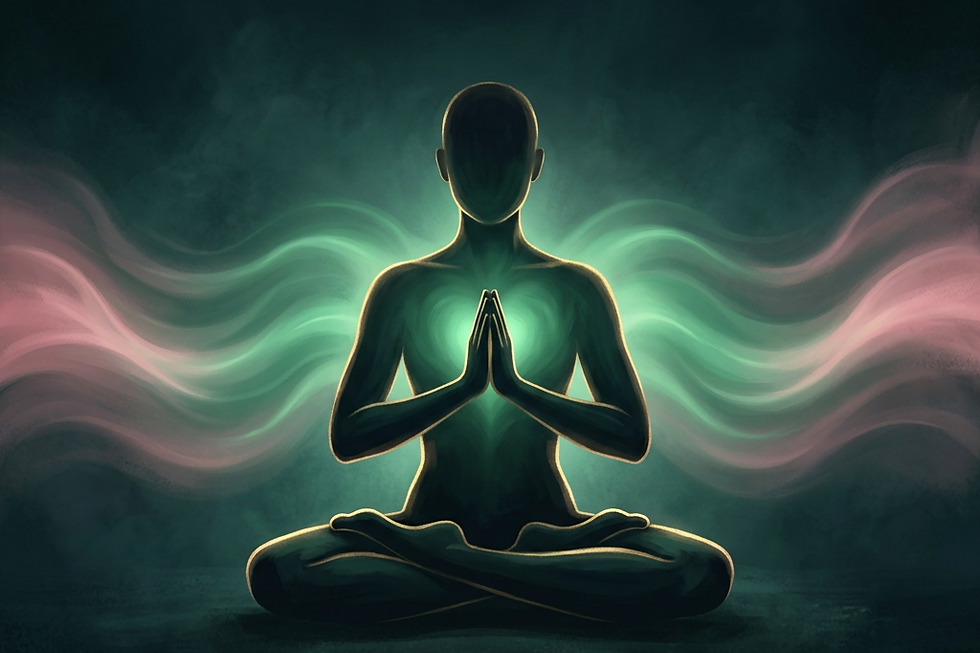
This practice is simple. It asks only that you slow down and arrive.
Time: 10–15 minutes
Best used: Morning to open the day with presence, or evening to release what the day carried in.
1. Settle and arrive (2 minutes)
Find a comfortable seated position, or lie down if that serves you better. Close your eyes. Take three slow, deep breaths — not controlled, just generous. On each exhale, let your shoulders drop a little further.
2. Bring awareness to the chest (3 minutes)
Place one or both hands over your heart. Feel the warmth beneath your palms. Notice the rise and fall of your breath in that space. You don't need to change anything — just feel it. The chest is often where we hold what we have not yet processed. Let your presence here be a kind of permission: it's safe to feel.
3. Chant or silently repeat YAM (5 minutes)
The mantra YAM (pronounced yum) is the seed sound of the heart chakra. You can chant it aloud — a soft, resonant tone that vibrates in the chest — or repeat it silently with each exhale. Let the sound be gentle, not effortful. As you chant, visualize a warm green light at the center of your chest, like sunlight through leaves. With each breath, let it grow a little brighter, a little softer, a little more expansive.
4. A moment of loving-kindness (3 minutes)
When you feel settled in the heart space, bring to mind someone you love easily — a person, an animal, a place. Let the feeling of warmth toward them fill your chest. Then, gently, direct that same warmth toward yourself. You might place your hands more firmly over your heart and silently say: I am worthy of love. I am open to love. I am love.
If resistance arises — and it often does — simply notice it without judgment. The heart doesn't need to be forced open. It opens in its own time, when it feels safe enough.
5. Return (2 minutes)
Let the visualization fade. Take a few natural breaths. When you're ready, gently open your eyes.
Additional Tools for Heart Chakra Healing
Sound and meditation are foundational, but healing is multi-dimensional. Here are some other practices you might weave into your daily life:
Crystals: Rose quartz, green aventurine, and rhodonite are traditionally associated with the heart chakra. Holding them during meditation or keeping them near you during the day can serve as a physical anchor for your intention.
Essential oils: Rose, jasmine, ylang-ylang, and bergamot are heart-opening scents. Diffuse them during meditation or apply diluted to the wrist or chest.
Movement: The heart chakra is associated with the element of air, so any practice that opens the chest and invites expansive breathing helps. Yoga postures like camel pose (ustrasana), cobra (bhujangasana), and supported fish (matsyasana) gently stretch and open the chest cavity.
Nature: Because the heart chakra's color is green and its element is air, time spent outdoors — especially in green, growing spaces — naturally supports it. Walk slowly. Notice what is alive around you.
Journaling prompts:
Where in my life am I withholding love — from others, or from myself?
What am I still carrying that I am ready to forgive?
What does it feel like to be loved well? Am I allowing that?
Closing: The Unstruck Sound
Anahata. Unstruck. The sound that needs no collision to exist.
The name alone is medicine. It suggests that at the center of your chest, beneath every story about whether you are lovable or broken or too much or not enough, there is a frequency that has never been damaged. It has not been struck. It simply is.
This chakra asks one thing of you: presence. Not performance, not perfection, not the relentless earning of love. Just the willingness to be here, in your chest, with whatever is there.
That is where healing begins — not with the mind figuring it out, but with the heart agreeing to feel.
In our next post, we'll move upward into the throat chakra (Vishuddha) — the center of authentic expression, truth-telling, and the courage to be heard. If you've been doing this inner work quietly, building your foundation from the root through the heart, the throat chakra is where you'll begin to speak it into the world.
Until then, let yourself be soft where you can.
This is the fourth post in Soft Currents' 7 Chakra Series. If you're just joining us, you might like to start with our guides on the Root Chakra, Sacral Chakra, and Solar Plexus Chakra before continuing here.
Keywords: heart chakra, Anahata, heart chakra healing, 639 Hz, chakra balancing, chakra meditation, how to open heart chakra, heart chakra blocked symptoms, YAM mantra, love frequency, energy healing, chakra series


Comments