The Power of Sacred Sound: A Comprehensive Guide to Mantra Meditation

In a world that rarely stops talking, finding a moment of true, restorative silence can feel like searching for an oasis in a desert. Our minds are constantly bombarded with notifications, endless to-do lists, and the ceaseless chatter of our own inner monologues. For many of us seeking peace, the instruction to simply "empty the mind" during meditation can be deeply frustrating. How do we quiet a mind that is accustomed to moving at the speed of light?

This is where the ancient, transformative practice of mantra meditation becomes a vital tool. Rather than fighting the mind's natural tendency to think and produce inner noise, mantra meditation provides the mind with a steady, soothing anchor. It harnesses the profound power of sound—a core principle we deeply cherish here at Soft Currents—to gently guide the nervous system into a state of deep relaxation and elevated awareness.
Whether you are a seasoned meditator or someone just beginning to build your personal sound sanctuary, understanding and practicing mantra meditation can profoundly shift your daily reality.
What is a Mantra?
To understand mantra meditation, we must first look at the word itself. The word "mantra" comes from the ancient Sanskrit language. It is broken down into two distinct parts: man, which means "mind," and tra, which means "vehicle" or "instrument." Therefore, a mantra is literally an instrument of the mind. It is a vehicle designed to transport you from a state of mental turbulence to a state of profound stillness.
A mantra can be a single word, a sound, a syllable, or a short phrase. Historically, mantras were chanted by Vedic sages in India thousands of years ago. They discovered that specific sound frequencies, when repeated with intention, created distinct vibrational patterns in the body and mind.
Unlike the modern concept of an "affirmation"—which is typically spoken in your native language to rewire conscious thought patterns (e.g., "I am worthy of love")—a traditional mantra is often less about the intellectual meaning of the word and entirely about the vibration of the sound. When we chant a mantra, we are not just thinking a thought; we are physically vibrating a specific frequency throughout our energetic body.

The Science and Philosophy of Sound Healing
At Soft Currents, we often explore how healing frequencies can restructure our internal environment. Mantra meditation is perhaps the most personal form of sound healing because you are the instrument generating the frequency.
The Vibrational Impact on the Nervous System
When you chant a mantra, either out loud or silently in your mind, you stimulate the vagus nerve. The vagus nerve is the longest cranial nerve in the body, running from the brainstem down to the abdomen, interacting with the heart, lungs, and digestive tract. It acts as the command center for the parasympathetic nervous system—your "rest and digest" mode.
The rhythmic repetition of a mantra, combined with the controlled breathing required to chant it, signals the brain to release calming neurotransmitters. Cortisol (the stress hormone) decreases, while serotonin and dopamine levels rise. Your heart rate slows, your blood pressure stabilizes, and your brainwaves shift from the rapid, stressful Beta state into the calmer Alpha, and eventually, the deeply restorative Theta state.
Resonance and Energetic Clearing
Just as specific frequencies like 396 Hz or 528 Hz can target specific emotional blockages and energetic centers, the sounds used in mantras carry their own resonant frequencies. Sound is not just heard by the ears; it is felt by the cells. The continuous vibration of a mantra acts like an acoustic massage for your internal organs and energetic pathways, clearing out stagnant energy and making room for clarity and flow.
The Profound Benefits of Mantra Meditation
Engaging in a regular mantra meditation practice offers a vast array of benefits that touch every layer of your being—physical, mental, and spiritual.
1. Unmatched Mental Focus and Clarity
The primary struggle most people face with silent meditation is the wandering mind. A mantra gives your active mind a focal point. Whenever you notice your thoughts drifting to your grocery list or an upcoming meeting, you gently bring your attention back to the sound of the mantra. Over time, this builds incredible neuroplasticity, training your brain to sustain focus and easily detach from distracting or negative thought loops.
2. Deep Emotional Regulation
Emotions are essentially energy in motion. When we experience trauma, anxiety, or grief, that energy can become trapped in the body. The rhythmic, vibrational nature of mantra meditation creates a safe container to process and release these trapped emotions. It provides a sense of grounding, helping you feel securely rooted in the present moment rather than lost in anxieties about the future.
3. Enhancing Spiritual Connection
Beyond the physical and psychological benefits, mantra meditation is a deeply spiritual practice. It is a pathway to connecting with your higher self. The repetition of sacred sounds naturally peels away the layers of the ego, allowing you to access the quiet, eternal wisdom that resides within you. It is a process of remembering who you are beneath the noise of the world.
Powerful Mantras to Begin Your Journey
If you are ready to integrate this practice into your life, you might be wondering which mantra to choose. The beauty of this practice is its flexibility; you can choose a traditional Sanskrit sound or a modern phrase that resonates with your current needs.
Traditional Sanskrit Mantras:
Om (or Aum): Known as the primordial sound of the universe. It is said to contain all other sounds within it. Chanting Om creates a vibration that resonates in the center of the chest and the crown of the head, bringing a profound sense of unity and peace.
So Hum: This translates to "I am that." It is often synchronized with the breath—silently chanting "So" on the inhale, and "Hum" on the exhale. It connects you to the universal life force and is excellent for grounding.
Sat Nam: A foundational mantra in Kundalini yoga, translating to "Truth is my identity." It is a powerful tool for clearing away self-doubt and aligning with your authentic self.
Om Mani Padme Hum: A beautiful Tibetan Buddhist mantra that translates roughly to "The jewel is in the lotus." It is chanted to invoke compassion, both for oneself and for all living beings.
Modern, Meaning-Based Mantras: If Sanskrit feels unfamiliar, you can absolutely use English words or phrases that carry a vibration of peace.
"Peace begins with me."
"I am grounded, I am safe."
"Let go."
"I choose love."
How to Practice Mantra Meditation: A Step-by-Step Guide
Starting a mantra meditation practice is wonderfully simple. It requires no special equipment, only your presence and a quiet corner of your home.
Step 1: Create Your Sound Sanctuary
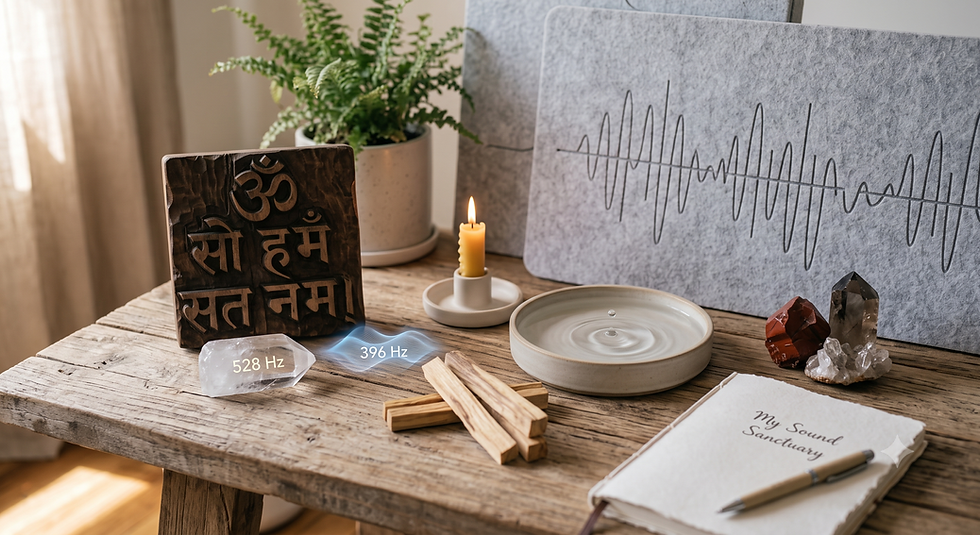
Find a quiet, comfortable space where you will not be disturbed. You may want to dim the lights, light a candle, or burn some cleansing incense. If you enjoy working with crystals, holding a grounding stone like Smoky Quartz or Red Jasper can beautifully anchor your energy during the practice.
Step 2: Find Your Posture
Sit comfortably. You do not need to sit perfectly cross-legged on the floor if that is painful for you. You can sit in a chair with your feet planted firmly on the ground. The most important aspect of your posture is keeping your spine straight. A straight spine allows your breath to flow freely and ensures the energy (prana) can travel up and down your energetic centers without obstruction.
Step 3: Choose Your Mantra and Set an Intention
Select the mantra you will work with for the session. It is highly recommended to stick with the same mantra for at least 21 to 40 days to truly allow its specific vibration to integrate into your nervous system. Take a moment to set an intention for your practice—perhaps you are seeking peace, clarity, or simply a break from stress.
Step 4: Breathe and Begin
Close your eyes gently. Take three deep, cleansing breaths—inhaling deeply through the nose, and sighing the air out through the mouth.
Begin repeating your mantra. You can choose to chant it out loud (which provides a stronger physical vibration in the chest and throat) or repeat it silently in your mind. Allow the mantra to fall into a natural rhythm with your breath. For example, if you are using So Hum, think "So" as you breathe in, and "Hum" as you breathe out.
Step 5: The Art of Returning
This is the most crucial step. Your mind will wander. You will suddenly find yourself thinking about a conversation you had yesterday. When this happens, do not judge yourself or get frustrated. Simply notice that your mind has wandered, and gently, with deep self-compassion, guide your focus back to the sound of the mantra. Every time you bring your mind back, you are strengthening your mental resilience.
Step 6: Gentle Closure
Continue this repetition for 10 to 15 minutes. When you are ready to finish, stop repeating the mantra, but keep your eyes closed for a few more minutes. Sit in the stillness you have created. Notice how your body feels. Notice the quality of your breath. When you feel ready, take a deep breath, gently wiggle your fingers and toes, and slowly open your eyes.
Elevating the Experience: Mantras and Healing Frequencies
To take your practice to an even deeper level, consider combining your chanted mantra with ambient healing frequencies. Playing a subtle, continuous frequency in the background can amplify the effects of your meditation.
For instance, if you are chanting a grounding mantra for your Root Chakra, playing a 396 Hz frequency in the background can deepen your sense of security and help liberate you from fear and guilt. If you are using a mantra to clear emotional blockages and ignite creativity, playing a 417 Hz track can beautifully support that intention. The external soundscape of the frequency merges with the internal soundscape of your mantra, creating a powerful, harmonious resonance that washes over your entire nervous system.
Embracing the Vibration
Mantra meditation is a profound reminder that we have the power to alter our internal state at any given moment. By simply changing the station of our inner dialogue—tuning out the static of anxiety and tuning into the clear, resonant vibration of a sacred sound—we can fundamentally transform how we experience the world.
Take your time with this practice. Start with just five minutes a day. Allow the sounds to wash over you, and trust in the wisdom of the vibration. The peace you are seeking is not something you need to desperately chase; it is something you cultivate from within, one syllable, one breath, and one frequency at a time.


Comments